
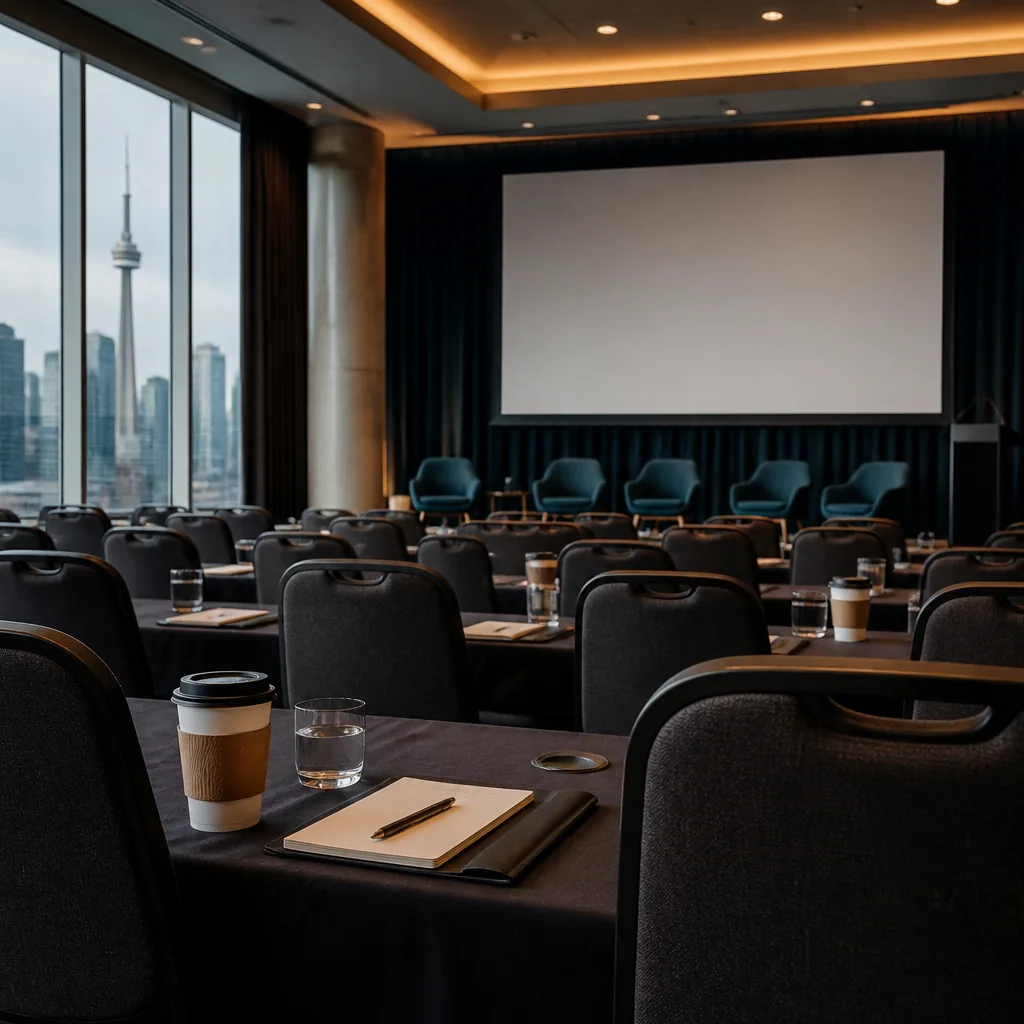
What follows is a first-person account: what we expected, what we experienced, and what was later refunded.
Why we travelled from Ottawa to SEO IRL 2026
My business partner and I attended SEO IRL 2026 in Toronto on October 6–7. We bought two tickets, booked accommodation, travelled from Ottawa, and took two days away from running our SEO businesses. We were genuinely excited to learn.
The event promotion emphasized real-world SEO results, proven strategies, and speakers who could show what works. We understood that as a promise of practical education: examples with enough detail to evaluate what was done, why it was done, how long it took, and what changed. We were not expecting a guaranteed formula or every presenter to reveal private client data. We did expect a meaningful amount of evidence-backed instruction.
That distinction matters. A conference can be professionally run and still miss an attendee’s educational expectations. My use of “misleading” in this review refers to the gap we felt between results-focused promotional language and the sessions we experienced—not a finding about intent or a claim that every person who attended was disappointed.
What SEO IRL 2026 promoted before the event
In the promotional material we reviewed on the SEO IRL website, the event used phrases including “Real-world results,” “Have the receipts,” “No theory, just innovative SEO that works,” “Real-world test results and up-to-date tactics,” and an invitation to “Duplicate the strategies and tactics that actually move the needle.” We saved screenshots of the claims as we saw them. A more detailed account with those screenshots is available in our SEO IRL 2026 notes and source material.
Those phrases shaped what we expected to learn. For us, “have the receipts” meant more than an engaging talk about an interesting idea. We expected to see at least some sessions connect a specific SEO intervention to a baseline, implementation steps, a timeline, and measured outcomes—with limitations explained. Others could reasonably interpret the event differently, but this was the standard we brought because of the promotion.
Promotional copy can be aspirational, but when it repeatedly emphasizes results and test data, attendees should be able to understand what kind of evidence and practical detail the program will actually contain. That is the expectation gap at the centre of my review.
What we experienced across 12 SEO IRL talks
Of the 12 speakers we listened to, approximately 10 did not provide what I would consider a concrete case study connecting a specific SEO tactic to measurable results. I was looking for details such as the starting point, the exact implementation process, the timeline, ranking or organic traffic changes, and the data used to evaluate the result.
We heard plenty of discussion, but in our experience there was not enough actionable, evidence-backed instruction to reproduce the strategies we believed the event had promised. This is a description of the talks we attended and my threshold for a case study. It is not a claim that every presentation had no value, that every speaker made the same kind of presentation, or that other attendees learned nothing.
There are fair reasons a presenter may not be able to reveal client identities or confidential analytics. A useful anonymized case study can still explain the context, the work, the timing, the comparison method, and what did not work. When privacy limits exact numbers, a speaker can say so and describe the evidence they can share. That level of transparency would have helped us distinguish practical instruction from general discussion.

What Semrush estimates can—and cannot—tell us
After questioning the educational value, I looked up several websites associated with speakers using Semrush. Some appeared to have surprisingly low estimated organic search traffic. Those figures are third-party estimates, not the sites’ analytics, and I do not treat them as verified traffic totals.
A speaker’s website traffic is not a reliable stand-in for their SEO skill, their clients’ results, or the value of a presentation. A practitioner may work on client sites, private projects, new sites, or channels that are not reflected by a public domain estimate. I am not using Semrush to accuse any named speaker of poor work.
The estimates raised a question for me, not a verdict: when a conference promotes proven SEO results, should the speakers and organizers make it easier for attendees to see what evidence supports the strategies being taught? I believe the answer is yes. The evidence should come from presenters’ actual examples and disclosed methods, not guesses based on a tool’s estimate of a personal website.
My conversation with organizer Steve Toth
My business partner and I spoke with organizer Steve Toth to share our concerns. We started by complimenting the event’s organization before explaining that we were disappointed with the educational content. Based on my recollection, the conversation shifted away from our main concern, and Steve eventually walked away before we felt it had been addressed.
That interaction added to our disappointment. This is my account of a brief conversation from my perspective; I cannot speak to what Steve intended or how he would describe the exchange. I also want to acknowledge the action he later took: Steve refunded both conference tickets in full on October 7, 2026. I appreciate that he issued those refunds.
The refund is relevant context, and it does not change what we experienced in the sessions or how the conversation felt to us. Both facts can be true at once.
The ticket refund did not reimburse our travel costs
As of October 9, 2026, both ticket purchases had been refunded in full. Our accommodation and travel expenses had not been reimbursed. We also spent two days away from operating our businesses. I am not assigning a dollar value to that time or claiming a specific amount of lost revenue; I am explaining the practical cost of travelling to an event based on its advertised educational value.
The ticket refund was appropriate, and I give Steve credit for providing it. It returned the ticket price, but not our lodging, transportation, or the time and opportunity we committed to attending. My criticism was never simply about the ticket price. It was about the difference between the education we expected from the promotion and what we felt we received.
For clarity: the two tickets were refunded; travel and accommodation were not reimbursed as of this update. I am not suggesting that every attendee should receive the same outcome or that a refund determines the quality of every session.
Why the SEO IRL marketing felt misleading to us
I believe “misleading” is fair as a description of our experience because the emphasis on real-world results and replicable tactics led us to expect substantially more detailed case studies than we heard. I am not stating that the conference was intentionally deceptive, that all talks lacked value, or that every attendee should share my conclusion.
Other attendees may have valued the networking, community, particular speakers, or broader industry discussions. The event itself was professionally organized. Those points do not erase our experience, and our experience does not erase theirs. The most accurate account makes room for both.
For a broader look at what evidence-backed SEO instruction can include, see our [[practical guide to SEO services in Ottawa|/blogs/seo-services-ottawa]] and [[Ottawa SEO planning guide|/ottawa-seo]]. The principle is similar: separate a claim from the evidence that supports it, state what the evidence cannot show, and avoid turning an estimate into a fact.
What SEO conferences should show when they promise results
If an event advertises tested tactics and measurable outcomes, its program should help attendees see how the promise will be delivered. Speakers do not need to disclose confidential client information. They can still explain the problem, baseline, audience, changes made, sequence, timeline, measurement method, observed outcome, and important caveats.
Organizers can make the expectation clearer by labeling sessions accurately: case study, tactical workshop, strategy discussion, research presentation, or networking. They can ask speakers to identify what attendees will be able to reproduce after the session. A little specificity before ticket purchase helps people judge whether the event fits their goals.
Attendees can also ask questions before buying: How many sessions will include documented case studies? Will speakers share implementation steps and measurement methods? Is the main value education, networking, or both? Are recordings or materials included? These questions are not an attack on an event; they are reasonable diligence when travel, accommodation, ticket fees, and work time are involved.
Was SEO IRL 2026 worth it for us?
For my business partner and me, the educational experience did not justify the investment of two tickets, travel from Ottawa, accommodation, and time away from our businesses. The ticket refunds softened the direct cost, and I appreciate that they were issued. They did not make the event’s educational value match what we expected when we decided to attend.
I am not claiming nobody benefited. If someone attended mainly to network or found practical value in sessions we did not, their assessment can differ from ours. My conclusion is narrower: based on the speakers we listened to and the evidence we were hoping to learn from, we were disappointed.
I welcome different perspectives from people who attended SEO IRL 2026, including people who found the event worthwhile. A fair discussion should compare what was advertised, what different attendees experienced, and what each person considered useful—not turn one account into a universal verdict.
Reader questions
SEO IRL 2026 review: key details
What is this SEO IRL 2026 review based on?
It is a first-person account from one attendee and their business partner, who travelled from Ottawa and listened to 12 speakers. It describes their expectations, session experience, conversation with organizer Steve Toth, and refund update. It does not represent every attendee or prove anyone’s intent.
Were the SEO IRL 2026 tickets refunded?
According to the attendee’s notes, Steve Toth refunded both tickets in full on October 7, 2026. As of the October 9, 2026 update, travel and accommodation expenses had not been reimbursed.
Does Semrush traffic data prove a speaker is good or bad at SEO?
No. Semrush traffic figures are estimates, not a website owner’s analytics, and a speaker’s own site traffic does not establish their SEO ability or client outcomes. In this account, the estimates prompted a question about conference evidence; they are not presented as proof about any speaker.
Does this review claim that every SEO IRL talk was useless?
No. The author says approximately 10 of the 12 speakers they listened to did not provide the kind of concrete, measurable case study they expected. They also acknowledge the event was professionally organized and that other attendees may have valued networking or particular sessions.
Why does the review use the word “misleading”?
The author uses “misleading” to describe the perceived gap between results-focused promotional language and the educational detail they experienced. The review does not claim to prove intentional deception or speak for all attendees.
Related reading
Keep exploring the decisions behind the site.
More context
A first-hand account is a starting point, not a verdict for everyone.
I welcome other attendees’ perspectives, including people who found value in the sessions or networking. For a practical companion, read our guide to evaluating SEO services and evidence.
Read the Ottawa SEO services guide